Sunday, April 17, 2011

Rights of the Unborn


          Years of Obstetrics practice has failed to resolve a dilemma that haunts me. Should I or shouldn’t I oblige this couple before me who have come requesting for an abortion?  Should I respect their wishes and do a favour to the demography of the country and interests of the family by reducing the count by one? Or should I fear the Unknown, bat for the unborn, and refuse the abortion?       
Abortion is defined as the termination of pregnancy before the viability of the foetus. The catchword here is VIABILITY- which means the capacity of the newborn to survive on its own with little outside support. In India, this period is about 28 weeks (total human pregnancy is 40 weeks) but western countries have been constantly reducing this period of viability and now it is as less as 24 weeks! Thus, it means any termination of pregnancy before 28 weeks is abortion. However, abortion laws in India do not permit termination beyond 20 weeks of gestation.
            Here then is the main contention. Can a foetus, alive within the mother’s womb, be considered an individual? If yes, from what age does it merit its own rights? After 28 weeks? After 20 weeks? Or at conception? Legally, the foetus is not granted an individual status.
 So, ‘Alive but not an individual’-can this status automatically confer sole rights to the biological parent/s to decide on an abortion? Probably yes. Because science has not invented ways to map fetal emotions let alone take consent from the unborn! Imagine someone holding a gun to your forehead. What would you say if he/she ever asked if you’d like to be killed? Don’t bother to think, for you’ve been emotionally numbed already. Because the person wanting to kill you is your favourite face-your mom or dad! And who in the whole wide world would ever fight against them for you?
            Which then trails down to yet another basic query- From when do I become ‘I am’ in the womb? At what point is the growing zygote no more a mass of cells but a tiny human entity? Is it at the first beat of a primitive heart (around 6 weeks of gestation) or at the first flailing of a limb bud (8-9 weeks) or the first sudden intrauterine breath?
            After the fusion of the sperm with the egg, the resulting cell (called zygote) begins its shaping out sojourn. One cell doubles (by 30 hours), then the daughter cells double...a mass of cells is formed. At one point, it is a miniscule round cell mass containing eight potent cells. If, at this stage, each of the eight cells is separated and allowed to develop separately, every one of them is potentially capable of developing into an individual! So at the eight celled stage, we are theoretically, eight persons in one-not yet ONE person! Only after further cell division, the 16- and 32 cell stages are reached (Blastocyst and morulla) and by then the cells are no longer omni-potent. So then, does my life start from after this eight-celled stage?
            It may seem very frivulous to discuss and dissect life at cellular level. But this technical dilemma is more pronounced in infertility clinics. For medical reasons, the couple have their eggs and sperms fused outside the body and the resulting zygote/s are then implanted into the uterus (In Vitro Fertilization or IVF) But in the process, more than one zygote may be obtained. And these are capable of forming into different individuals when implanted in the uterus. IVF clinics have various uses for this ‘extra’ embryos (note how life is trivialised even when in limbo). They are kept frozen for further use-either for the same couple later on or donated (Embryo donation) to other infertile couple or may end up as research material under a powerful microscope for lack of suitable takers!
 However, there have been unfortunate incidents of the biological parents dying in accidents or divorcing or even simply not wanting to have more than one child. What happens to the potential individual in the freezer? Who decides whether they should be preserved and if so, how long or should they be allowed to ‘die’? And who will take up the cudgels for a frozen mass of cells in some obscure corner of a freezer in yet another Infertility Clinic?
            Which then throws the question back at us-Is the unborn an individual meriting at least some if not all the rights of a citizen? Is abortion just another medical intervention or acceptable homicide?
During mid-2008, the Bombay High Court refused permission to Harsh and Nikitha Mehta for aborting their 26 weeks old foetus. The baby had a congenital heart disease and the medical faternity was divided on the prognosis for this baby after birth. So the petitioners had sought permission citing imperfection and because the foetus was over 20 weeks.
 Is it right to abort an imperfect unborn? If yes, then what is imperfection? By definition, an extra digit is imperfection and so is a huge hole in the heart or a total absence of skull, exposing an improperly formed brain. So, which foetus gets the full stop? It is almost unanimous amongst us that those anomalies that cannot sustain life merit abortion at the earliest in order to avert the physical and mental trauma the mother has to suffer if the foetus is allowed to grow full term. But what is the consensus on the borderlines? The anomaly, which is not lethal? What must be done to those babies with contorted ankles (Talipes equinovarus) or excessive water in the brain (hydrocephalus) or some gut anomalies that need to be operated after birth, or as in Nikitha’s case, a cardiac anomaly whose prognosis is unknown or guarded?
            Is it correct to allow the biological parents to make the decision? Has the unborn been asked? Its rights considered? Or should there be a human rights organisation fighting for every foetus coming up for abortion? If allowed to be born, what is the degree of mental, financial and medical burden the baby and her parents must go through? Who is expected to bear the costs-the unwanting parents or the organisation that fought for the baby? Is it worth the trouble?  The debate only gets more confusing with a clash of ethical, moral, financial, legal and personal issues.
Should individual status be granted to the unborn then? Make laws to protect them? A few years back a pregnant woman (beyond 28 weeks) was killed in an accident,in Gujrat, I think. The survivors claimed monetary compensation from the Insurance agency on behalf of the baby too, citing it was viable! Only the baby was dead like its mother and the life insurance money claimed would go to the kin whom it never saw or knew!



Saturday, April 9, 2011

My mother ran away!


I have discovered that one of the most emotionally charged and a labile moment for a woman is immediately after childbirth. Probably a sense of accomplishment or an acknowledgement of responsibility of adulthood emboldens even the shy and timid to become eloquent. Women often reveal very personal information during cesareans or normal deliveries when we are suturing them.
For my part, I sense that having helped them to deliver their facsimile, further promotes our patient-doctor relationship. At these times, they pour out their innermost insecurities and feelings.
            As the staff involved in a normal delivery is less than in a Caesar and the patient is not under anesthetic influence, the tete-a-tete is more direct. As I deliver the placenta and prepare to suture them, to keep some conversation going I often ask -“So, will you be going to stay with your mother?” Of course, I know that our girls go to their mother’s and stay there for up to nine months after delivery. My question is most often meant to be a light banter.
However, the responses to this simple question always give me an insight into the kind of life this woman may be living in a man’s world. Answering this innocuous question, they reveal more about themselves than they could ever guess.
And so goes the conversation and my assessment.
            “So, will you be going to stay with your mother?”

            “Yes doctor. I shall stay there for the next nine months.” The mother and child will be cared for well here. She comes from a close- knit family. A family that will accept her and her newborn girl and probably will not tolerate the in-laws if they grumble and accuse her of not having delivered a baby boy.

            “Yes. But not for long.” It could be that her absence from her husband’s home will be missed- probably as the loss of a helping hand. Or, there must be that first-born who had to be cared for too. A responsible woman, struggling to cope up with family pressures.

            “No. But my mother is coming here to help me out.” A responsible, older woman (the mother) valiantly coping up with extended pressures even when her children have begun their own families. This young woman will learn to appreciate the sacrifices of her mother and probably will emulate the same in years to come.

            “No. I may have to manage alone. My husband is busy.” The wistful sigh of the young girl who married against her parents wishes. No parents, no in-laws to turn to. This just out of teens is prone to disregard her health. The initial physical attraction in their marriage is already on the wane and in a few months, she will have the first real exposure to her husband’s character. I hope it will be a pleasant one!

            “No. My in-laws will not hear of it. They have had a row with my parents.” A great tension…most often for lack of dowry and a clash of egos. The poor lady will have to make a lot of compromises and if it is a female child, her other problems have just begun.

            But the irony of it all is that that the most startling answers are given out in a feeling-less voice. The pain of the memory becomes temporarily camouflaged by the recent even of labor and a sympathetic ear at such times will get its earful!
           
            “My mother stays with us, doctor. My father married again when I was born.” What was her mother’s fault? Delivering a girl baby! No wonder this young woman had such low perception of self-worth.

“I don’t have one, madam. She is dead….committed suicide when I was young.” Fifteen years of solitude as an orphan…No mother to braid her hair or pack her lunch- box or confide about her heavy period…Becoming, and playing the role of a mother will be a  challenge to this woman and she needs a lot of family support.

And finally, one evening, as I was doing her skin and popped the question, a patient said:
            “Doctor, my mother ran away.” A flat statement... I looked at her from my seat...dry eyes and a wry smile.
             I halt midway the second suture. Did I hear her right?  
            “What did you say?.... When?”
            “My mother ran away. Four days ago. She doesn’t know I have delivered.” A woman runs away at that age? And where to? This lady was 28 years and her mother could be in her sixth decade. Running away at 55?Eloping? Can’t be.
            “But…why?”
            “My father tortures her.” The bitterness in that voice haunts me even to this day.
            What do you call a man who abuses his wife even after the grandchildren are around? And how much of an abuse it must have been for the poor elderly woman to abandon a place she believed was her home and a man whom she had served for over forty years? Where could she have gone-talking along, suffering her depression, arthritis and all? It could probably be to anyone of her relatives’ houses...or to end up as a statistics on a railway track or float on a god-forsaken pond four days hence.
            “She might come back...when she learns you have delivered...” I tried to put off that vision.
            “No madam. Not this time...She has had far too much...We’ve lost her...” Now the new mother was crying. It was yet another moment of helplessness in my profession. I could neither continue the conversation nor look into those sorrowful eyes. And what consolation should I give this wretched woman?
            They taught me history-taking, examination and surgery in Medical Colleges; preaching Medicine was an inexact science...but no one had warned me that I could often be stumped by such emotional tempests....
            As I ripped off my gloves, I realized again that Medicine is very finite...


Sunday, April 3, 2011

The desperate spinster!


Poor Miss Under Stud
is communicatively challenged.

At front office job, she lasted a day.
“Hello? Miss Under Stud here!” she’d said.
Her esteemed caller was cross,
she was shown the doorway.

As a H.R manager,
she lasted a little longer.
Until she signed-“Under Stud.”
The umbraged client got it, ‘Understood?’
Alas, when she signed just- “U.S”,
its intimacy lured lechers
who inferred her amorous!

Lonely, Miss Under Stud
longed for a man who understood,
a quiet home and a little brood.
But she remained long un-wooed. 

For,
could she marry Mr. Side or Mr.Hand,
risk being called Mrs. Under Side or Under Hand?
To wed Mr. Ram or Mr. Bush
surely would indecency out-blush.

“ ‘Mrs. Under Stud’ makes out
a lesser man of me,” other suitors rued.
“Under Stud sounds so horsey and less mare-y too,
I can’t have her about!”

“Miss....U....Stud!? Are you?”
The kinky women would huskily leer.

And thus poor Miss Under,
paid for her parents’ blunder.
She willed her epitaph, at final surrender:
“Mis-Under-Stud-
she learnt to live with fortitude!”


Tuesday, March 29, 2011

Curtains before the show!


This happened in March too. Two weeks before my sixth birthday.
School Day was an exciting prospect and the preparations for it pre-occupied us all a month before the event itself. Being in school was more exciting than ever because there were only practice and rehearsals instead of counting and handwriting. Besides, being selected for a dance bequeathed celebrity status on a first grader!
“Shantala, Jayalakshmi, Jayasheela...”My class teacher Mrs. Padma would call out after the prayers. It was for practice. “Lucky them!” “Could we go and watch too?” The class would break into a restless murmur. Strutting to the door, I would leave behind bench-fulls of wistful faces and jealous hearts.
Practice was in the first floor of the new building that was due to open from the coming academic session. Our dance teacher was Mrs.Padma’s niece-pretty, lithe and all of eighteen. I loved to be her. Her colorful lengha-choli or half-sari ensembles.... mesmerized, I would watch her single long braid snake and swish on her backs when she danced.  “Don’t stand there dreaming. Common dance,” she would chide me. It was a Kannada song about a summer storm – “Eenidu dhooli? Ho! Ho! Gaali...suliyutha banthai suntara gaali...” it went; as dancing, we swayed and shielded ourselves from the oncoming gale. Four rows of two girls each and I was the second right, paired with Jayasheela. (I settled for No.2 because the teacher’s daughter had the natural right to be in the front!)
By the end of the first week, I was street-performing. All the way along, from and back home which was two and half kilometers from school, I would sing and dance the storm-song, oblivious to passersby. By middle of third week, everyone in my house knew the song by-heart. Only they didn’t care to learn the steps! The D-day was barely a week ahead.
We had no individual diaries for the teachers to write instructions. They just told us and we went back home and repeated the instructions. “Amma, Thursday is the School Day. Padma miss has asked me to be there by eight in the morning,” I had told my mother. She was excited too. It was after all my first stage performance! She had her standard set of instructions (“You must concentrate on dancing. Don’t search for me in the crowd. You know I’ll be there watching you, all right?”) And admonishments. (“Haven’t I told you to leave the dance dress alone? Keep trying it out often- it will sure be dirty for your school-day!”)She had stitched the dainty long skirt and the matching sleeveless choli. We had shopped for matching bangles, necklace and nail polish. The henna leaves were procured from her friend’s garden and she had ground it into a fine powder. It would adorn my hands the night before the D-day. She even let me wear the gold ‘jhumkis’ which were my festival-exclusives.
However, as a final confirmation, my mother chatted up with the ayah, who was my escort to and from school daily.
“Tomorrow, isn’t it, Gowramma?”
“Hmmm..”
“She says we have to be there by eight?”
“Avva...Always the programme starts only after eleven thirty. If you dress her up here only, then you can report by eleven also.” she suggested. The idea appealed to my mother.
                She washed my hair the next day. Braiding into a plait, she adorned it with colorful tassels and flowers. All the while I kept whining,”Amma, Padma miss said eight o’clock!”
‘That’s ok puttu. I will tell her. Children who want to get dressed at the venue need to report early. I am doing all that here itself....it will keep you from sweating in a crowded green room,” she cajoled me.
And so, at a quarter past ten we set out. Being dressed in dance finery kept me from frisking. I had to walk only. “Thank God.  That’s more lady-like” amma had grumbled. People on the street nodded or smiled indulgently. Some even came across to pinch or peck at my cheeks. I hated it. “Amma, my  rouge got smudged! Oh! The powder rubbed off!” I would whine then, prompting her to pull out the make-up box and fix my face under the next tree. I did however manage to run the last few yards to the school. “Amma, I am thirsty. I will drink water and come back,” I had said disappearing into the compound. Actually, I had asked my friends to wait for me at the school tap. I wanted them to see all my finery before I went on stage.
The place was empty. I ran to the washrooms and there was no one there too. “They ought to have been here by now...” I thought as I dragged myself back to where my mother was standing. I didn’t  see her face. But looking beyond her, for any trace of my friends, I asked her, ‘Amma, what time is it now?” She knelt down and took me into a tight embrace. I squirmed. ‘Amma, you are spoiling my skirt...”I tried pushing her.
“Sweetheart, I should have listened to you...Your dance is over baby,” she said. As I was still pushing her away and looking for my friends, her words failed to sink in. “Lets go in Amma. They must be getting ready in the green room.” I said finally freeing myself and running forward. “Shantu, listen to me. Your dance got over an hour ago..” she repeated. I thought she was insane. I thought she was lying. How could it happen? I was the star dancer.. I ran inside and stopped agape at the door of the noisy auditorium! I saw all of them...laughing and clapping...the show was already on!
My friends spotted me at that moment.
“Hey, what happened to you? Why didn’t you come for the dance?”
“Why, you’re even dressed!”
             “Aunty, why didn’t she come?”
“Hey, Shantala, wait till Padma miss sees you. You’ll get it.”
 “Oh, the cleverest girl in class and she misses the dance!” someone snickered.
My mother was by me then trying to hold my hand. “You know putti, the ayah had got it wrong. The primary school function-yours- was in the morning and the middle school was for the afternoon. Sorry sweetheart. Look at me,” she was saying. I refused to let her hold my hands and ran away. Head bent, l rustled my beautiful cream skirt with saffron border and tinkled the matching bangles. Kneeling down, I pretended to finger my new silver anklet, hoping no one would see my tears. People were milling all around me. The henna on my hands looked redder than ever, drenched in my tears. I didn’t care now if anything smudged my kohl or rouge. Could this be happening to me? ‘She’s my best student!” hadn’t the dance teacher often said? And I missed the dance?
Someone pulled me erect. It was Mrs. Padma.
“Hey, aren’t you the bold girl? And you’re crying? Common, it wasn’t your fault. It’s OK. There is always a next time,” she took me in her arms, as amma looked on. That didn’t help. It only dug in deeper. So losing out- for no fault of mine, hurt even more than losing itself.
“Look here, sweetie. So what if your dance is over?  You could still be on stage, “she said, hoisting me onto someone else. The next moment I was in the arms of our principal, Mr. B.P. Rao. “Common, child. Up you go on the stage. They are beginning to sing, join them,” so saying, he set me on the stage- first row and forward! I looked behind me, staring at two-three rows of new faces- older children, all happy to be on stage, ready to sing. “I practiced the storm-dance. I don’t know any song.” But no one heard me. First row forward, even lip sync could be caught!  Helplessness only doubled my sorrow then.  I looked sideways, to scoot off the stage. Before I could even take a step, the room went quiet and the song began.
“Jana gana mana adhinayaka jayahe...” The National anthem! Of course, that was a song I could well sing! Not relief, but a deep sadness washed over me then.  The happy hours of practice, the beautiful dress, henna, jhumkis...the futility flooded me! I stood there, the only one not singing the National Anthem, with tears streaming down my cheeks as the principal, teachers, friends, amma and all dulled into a misty blur.... For me, being on stage was no consolation to not performing.
The show was over. The red curtain came slowly down.

Mirage (Pastels on paper)


Sunday, March 27, 2011

Gender swap!


That dawn he delightedly discovered that his prayers were answered. Dreams did come true! Jumping out of bed, he looked about, fondly at his wife’s body. Bountiful at the right places......he hugged her, hugging himself, loving the unique feeling...
“Thank You Lord!” he exalted. But by then God had just condensed into a golden bubble and had gone ‘plop’. What a conversation that had been! God had condescended and talked to him, coming to his bedroom!
“Son, it must be a woman’s matter that’s causing you to hound me 24/7 with your woeful pleas. Out with your troubles before my wife discovers I have changed bedrooms in the middle of the night!”
“Mercy, my Lord! What have I done to deserve this life of monogamy, nagging and being a thankless ATM? These seven years have taken a toll on my body. The heart that skipped a beat on just glancing at her then, now almost stops when she starts a monologue. The throat refuses to vocalize despite the mind being in an expletive mode!
After an exhaustive day at office, what do I return to? A long list of groceries, electricity/ phone bill, a demand cloaked as a request for a holiday or jewelry and a threat to keep off the bed at night if I do not oblige.
When you called us your children, why did you bless us with some more? And none as docile and dad-fearing as I have ever been all my miserable life. Keeping a tab on and copying their peers’ lifestyle for them, keeping away from that desperate cigarette and that beckoning beer till they are out of sight, suffering the admonishments at the parents-teacher meet....I envy your laid back attitude as Father.”
God wiped his eyes. “What can I do for you now?”he sniffed.
“Let me be her.”
“What? I thought you wanted her-” God made a very ungodly gesture, drawing a forefinger across his neck with a matching sound.
“Thanks, but no. I want to experience the fun she has everyday. Imagine God...packing us off and having nothing to do the whole day except watch T.V serials, manicure, pedicure, bleach, tweeze, wax and most enviably, gossip! Eight hours of sleep, twelve of pleasure and only four grumbling-working hours a day! Compare it to mine- four hours sleep, twelve of boss-pleasing, back-breaking drudgery and eight of nagging-wife and devilish-brats? How much worse can your math and skewed your vision be?
So, all I wish is to experience the pleasure of being a woman, at least one day, in this life time!”
“So be it.” God had granted and here he was, in her body.
By eight in the morning, he had trundled off the imps and the husband and was looking forward to a luxurious mid-morning with TV, newspaper, hot coffee and a relaxed dip in the bath. But the pile of clothes waiting to be washed beckoned him and later transferred him to the mound of unwashed vessels and then commissioned him to floor sweeping and mopping.
“Honey, do we need a servant? They are so unreliable. I’m sure you’ll be better without them,” he remembered saying, cleverly saving seven hundred rupees.
By afternoon, the breaking back was only thankful to be rested, oblivious to the hungry stomach. But at that moment, the children were back-noisy and demanding to be waited upon.
Evening meant shopping for vegetables, planning the next day’s menu, ironing uniforms, polishing shoes, all the while being compared to a working woman who, unlike her, was more worthy and monetarily productive too!
By ten, he was exhausted. He was missing his body. Just a few more hours and I shall never pray for anything like this, he told himself. He realized that his haves were better than his better half’s! Just as he switched off the bedroom lights, he felt his husband’s hand groping roughly. Oh another chore! That night, he realized the sea of difference between ‘Hrrruumph’ and ‘Ah...Ouch!’
At the break of dawn, God reappeared. “Thanks, my Lord. Switch us back,” He couldn’t wait. But God seemed to be in no hurry. There was a halo of guilt around him. The mortal was mortified.
“ Gawd! Is something wrong?”
“Son, I’m afraid it is.....I can’t help you...For another 40 weeks. You just got pregnant last night!” This time God disappeared without a pop!


Thursday, March 24, 2011

Patient abuse


We barely had eight weeks for the final MBBS exams. As a part of preparations, we would scout the hospital wards for interesting cases, examine, and discuss them.
So when we heard of an interesting case in male surgical wards, Unit C, we decided to see the case after lunch. In the ward, it was unnecessary to ask about the interesting case because there were already a dozen of our classmates around a cot in the farthest corner. Just then the patient, Mr. Ramappa, who had gone out for a late, hurried lunch came in.
He looked at all of us- in white coats, dangling steths, manuals and notebooks in hand; and with an audible sigh sat on his cot. A sudden vision of pithing slimy frogs in second MBBS floated before me. (Pithing- to study physiology of muscle and nerves, we had to make a muscle-nerve preparation from the legs of a frog. For that, we had to ‘boldly’ stick a long thick needle at the bent neck of a LIVE, wriggling frog! And, as its spinal cord severed, it would go limp and we would proceed dissecting the poor creature!) Discussions died down and each one of us began taking turns examining him.
Ramappa was a case of Thyroid swelling. (Thyroid- a gland that is present in the front part of the neck and is not visible as an obvious swelling in health) The examiner is required to stand behind the patient and the patient has to bend his neck for examining any neck swelling. So Ramappa sat, his head bent and turning from time to time when ordered as each student took an average of seven to ten minutes to examine him. Looking at his neck from front, we would ask him to swallow and note down in our books whether the lump moved with deglutition (swallowing) At one point after he had obliged twelve of us, he asked: “Could I drink water? My mouth is dry and I have to drink something to show swallowing.”
It was my turn next and as I started with inspection. (The first part of any examination is inspection-that is to see before we touch) I noticed that the skin of his neck appeared sore. Were he a little lighter skinned, it would certainly be evident as a bruise. So many of us had handled his neck since past two days, that it must surely have been painful. But he had not complained. As I looked up from his neck, our eyes met. I could have well been looking into the eyes of a trapped animal. Pain, anger, helplessness were all there, coated by a thin film of a threatening tear.
‘Interesting cases’ are admitted during exam times for the benefit of students and as cases for examinations. These people are often poor and come to government hospitals for treatment. When they are admitted and scores of students come to see them, they initially believe that many doctors are seeing them. Few days later, the knowledge dawns on them that they are being kept as examination cases. Many of them oblige, probably because of the fear that they may not get the necessary treatment if they do not. Some of them run away from the wards either during student rounds or permanently.
Ramappa’s thyroid swelling was diagnosed as Cancer Thyroid. It was a very obvious diagnosis given his change of voice, fixed swelling, palpable lympnodes etc. Yet he was kept in the ward, pending treatment, so that he could be examined by future doctors who could get the ‘feel’ of a cancer lump!
This is where our Medical curriculum errs. No one ever teaches us how to empathize with patients. It is only mentioned as if an abstract emotion by some teachers. The soft-firm-hard –cystic feelings in diagnosing lumps, that we are taught in surgery, do not reach beyond our physical capabilities. When it comes to feeling for patients, we are on our own, without guidelines.  
But that day Ramappa had taught me an unforgettable lesson. I refused to lay my hands on his neck. It did not matter to me if I missed the feel of one cancer thyroid. I had felt his pain and I valued it as a greater clinical acumen than diagnosing cancer. Since then I have forgone examining Shivu (a ten year old with Hereditary Spherocytosis), Shankar (a seventeen year old with Wilson’s disease) and others....They have all spent not less than 2 weeks at the hospital being examined by innumerable number of students. Shivu’s large dream-filled eyes and Shankar’s wobbling gait, toothless smile and ambition to become a D.C stay with me as reminders of my final year days. They remind me always how lucky and privileged I am and that the least I can do to alleviate their suffering is to understand them as human beings and not as interesting cases!
Vases's eight (pastels on paper)


Tuesday, March 15, 2011

Kamakhya-Temple for the female Organ of Generation

     
The Kamakhya temple is situated atop the Nilanchal hills, eight hundred meters above sea level, overlooking the mighty Brahmaputra. It is about eight kilometers west from the heart of the city of Guwahati in Assam.
Kamakhya is an important Tantric mother goddess closely identified with Kali and Maha Tripura Sundari, according to the Tantric texts (Kalikapurana Stotra, Yoginitantram) that are the basis for her worship. Her name means "renowned goddess of desire.’  As Kamakhya is associated with fertility, many childless couples also throng the temple every day. In Kalika Purana, Kamakhya is referred as the goddess who fulfills all desires, the bride of Lord Shiva and the benefactor of salvation. Kamakhya is one of the 51 Shakthi Peetas of the sub-continent where Durga is worshipped in many forms.             
Mythology:  Sati (Dakshayini) the daughter of King Daksha who had married Lord Shiva much against the wishes of her father went, uninvited, to the Yagna that Daksha was performing. She was ridiculed by her father for attending without an invitation. Daksha hurled abuses at her husband and humiliated them. Deeply hurt and angry, Sati threw herself in the blazing fire of the Yagna and died. Shiva was infuriated. Killing Daksha, he hoisted the dead body of Sati over his shoulder and began the Thandava- a dance of Annihilation.
            This shook the universe and frightened the Gods. Lord Vishnu, Brahma and Shani ventured to put an end to the blind fury of Shiva. With the help of his Sudarshana chakra, Vishnu reduced the body of Sati to pieces and Shiva, without his wife’s body, returned to meditation.
            However, Sati’s body parts, 51 in all, fell all over the earth and each of these places is revered as holy. The organ of generation (Yoni or the genital organs) of Sati fell over the Nilanchal Hills and today is known as Kamakhya Temple. (Assam was known previously as Kamrup Kamakhya desa)
Kama, the God of Love who was reduced to ashes when his arrow targeted Shiva, regained his original form (Kamarupa) after he fulfilled his promise and built a temple for Sati.
            Mythology also has it that Narakasura tried to build the path to the temple overnight with a desire to wed Kali but was killed when he failed to do so.
            According to history, the original temple was destroyed by invaders and had to be restructured.  King Naranarayan of Cooch-Behar in the late 17th century is credited with building the present temple. Representing the old Ahom sculpture, the vertex of the temple is oval shaped; like beehive-having 7 spires, 3 golden pitchers on blossoming lotus and upon that a golden trident. The temple exterior flaunts beautiful frescos of adorned gods & goddesses of Hindu Puranas.
********************
The Ganeshas
            On arrival atop the hillock, priest Ramani Kant Sharma escorted us to the temple premises. He took us to the Sauvagya Kunda where we washed our feet and hands, sharing space with a duck and a curious monkey. We placed offerings before a row of strangely sculpted Ganeshas, anointed with bright red sindhoor before ascending a cool flight of stairs to the temple precincts.
            The premise abounds with goats that wantonly amble, amidst generous droppings and pigeons that make homes in the eaves of the sculpted exterior and the air is a mix of strange scents, all familiar but individually unidentifiable! Sadhus who eye visitors with a hypnotic gaze pit the compound. A cache of bronze bells of various sizes (offered by devotees for special favors) hung alongside a wall
Prayer bells

Is she bearing down?
     A particularly interesting sculpture on the walls captured me but I had no one to explain its significance. For my obstetrician eyes, it appeared as a woman straining during labor!
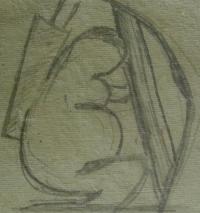
          Inside the dimly lit temple, a tightly coiled serpentine queue of devotees mills silently towards the sanctum sanctorum. It is quite claustrophobic. The doors to the outside are silver coated and the interior has strange sculptures. Photography inside the temple is prohibited. So I had to quickly sketch an intriguing sculpture. It is a pregnant warrior, kneeling, with her head bent, a bow in her left hand and a quiver with few arrows.
The pregnant archer
            Just before we enter the sanctum sanctorum, is an adorned platform for the idol of Goddess Kamakhya made of an alloy of eight metals. Kamakhya is pictured as a young goddess, 16 years old, with twelve arms and six heads (five looking front and one atop of them) of varying colors, representing a powerful goddess who is omnipotent, omniscient and omnipresent. She is ornately dressed, typically wearing a red sari, opulent jewelry and red flowers such as hibiscus. She holds in each of ten hands a lotus, trident, sword, bell, discus, bow, arrows, club or scepter, goad, and shield. Her remaining two hands hold a bowl, which is made of either gold or a skull. She is seated upon a lotus, which emerges from the navel of the corpse of Shiva, who in turn lies atop a lion. I cannot comprehend the mystical meaning in this (nor have I got it on the net, much as I scouted)
Kamakhya
Absently I offer rose petals to the draped and garlanded figurine for this is not the real object of worship. I am curious about the real object of worship.
            There are ten steep steps down into the Sanctum Sanctorum, which is lit by oil lamps only. It is beneath the largest temple dome as the walls here are circular, almost appearing to be closing in on us. It is very cool here. Going down the steps, I get a strange feeling of entering a gigantic, hushed womb!
At the actual site, I knelt, bending towards the ‘Devi Kunda’, which is the Mother’s Yoni (Vulva, regarded as the symbol of divine procreative energy). The Yoni exists as a large cleft in the circular rock, covered by water springing upward, constantly, from an underground spring. The soft gurgle sounds divine! I can see the spring clearly but the cleft is covered by a red cloth, flowers, and red sindur powder. I am directed to scoop a handful of water (which is supposed to be reddish due to high iron content. But the color is not visible in the darkness). “Piyo,” the priest says and I oblige a mouthful. The water tastes sweet and strangely, I find myself wishing it were Ambrosia! I run my wet hand on my hair.
            There is a similar neighboring wish-well attributed to Goddesses Lakshmi and Saraswathi. The ritual of par taking the sacred water is repeated.
            We come out of the temple and wade through a sweet cloud of dhoop sticks and Sharma suddenly assaults our olfaction. He takes us to the sacrificial place. The altar had been just cleansed with water for the smell of blood hung fresh in the air. “Three or four buffalos a month and almost the same number of goats daily,” Sharma says. Then the special Panchabali ritual involves the sacrifice of a buffalo, a goat, a sheep, a pigeon and a duck and is a common practice in the Kamakhya temple. All the wanton goats in the premises, the duck at the pond and the pigeons.... would all pass this station some day! I suddenly want to leave the place.
The goats go down here....


and the buffaloes here.....
            We walk down the steps along the alley of tiny shops which are by now open and displaying the trivia which are so characteristic of every such place of worship- marigold garlands, bright red gold laced chunnis, rudrakshas, photos of Kamakhya, idols of Durga, prasads, sweets and brass ware. Devotional songs set to contemporary Bollywood music blare over woeful sound systems.
            As we climb down the steps, brushing people climbing up to the temple, my right arm becomes moist. As I rub the generous mucus with my left palm, I realize that it is the saliva of a lamb that a devotee was carrying in his arms! I look back and lock eyes with it. The lamb is cute and black as it juts its wet spout beyond his cradling arms. Ten steps downward, I trip as it dawns that the lamb was being carried as a mid-afternoon offering to the goddess!